Army of clerks explores generative and algorithmic approaches in architecture and design. Its rationale is the investigation of a computed and a computing architecture, one performed through algorithms instead of represented through drawings and projections. Army of clerks seeks a new type of architectural aesthetics which are no longer grounded on the architects privileged point of view, but on the relentless accumulation of unintelligent calculations, mindless arithmetics performed by computational armies of clerks.
More.
Thursday, 16 October 2008
Welcome to Vernissage of Simon Key Bertmans Rugs.
Wednesday 22 oktober 16-19 at Bruno Götgatsbacken Gallerian i Stockholm. Götgatan 36
“7 rugs based on statistics, rules and aesthetic qualities”
+ a special art-work from Sapporo in Japan. Made by Hiroko Tsuchimoto
The exibition ends at 28 of oktober. Open every day between 11-19.
Map here.
“7 rugs based on statistics, rules and aesthetic qualities”
+ a special art-work from Sapporo in Japan. Made by Hiroko Tsuchimoto
The exibition ends at 28 of oktober. Open every day between 11-19.
Map here.
Wednesday, 15 October 2008
Architectural Prototypes: Modes of Design Development and Architectural Practice
by Jonas Runberger
The licentiate thesis was defended at KTH School of Architecture in Stockholm on September 30th 2008 with opponent Michael Speaks (PhD, Dean College of Design, University of Kentucky). The thesis was passed, leading to a Technical Licentiate degree in Architecture.
The licentiate thesis is divided into two parts; the Contexts book and the Projects book. The two books are intertwined through a system of references, and are meant to be read together. The Contexts book explores contemporary discourses within the field of digital and projective design and new forms of architectural practice. The Projects book is based in design projects developed by the Jonas Runberger, often in collaboration with other architects, and traces a discourse based on advanced parametric design methods and architectural effects.
The thesis is printed in a limited and numbered edition of 125. A small number of copies will be available for sale shortly, please contact jonas (at) runberger.net for more details.
PDF version here. Online version here.
The licentiate thesis was defended at KTH School of Architecture in Stockholm on September 30th 2008 with opponent Michael Speaks (PhD, Dean College of Design, University of Kentucky). The thesis was passed, leading to a Technical Licentiate degree in Architecture.
The licentiate thesis is divided into two parts; the Contexts book and the Projects book. The two books are intertwined through a system of references, and are meant to be read together. The Contexts book explores contemporary discourses within the field of digital and projective design and new forms of architectural practice. The Projects book is based in design projects developed by the Jonas Runberger, often in collaboration with other architects, and traces a discourse based on advanced parametric design methods and architectural effects.
The thesis is printed in a limited and numbered edition of 125. A small number of copies will be available for sale shortly, please contact jonas (at) runberger.net for more details.
PDF version here. Online version here.
Tuesday, 14 October 2008
A MOVIE ABOUT CONCEPTUAL ART: Monday 27th October
I'm going...EDG students and faculty are going....All welcome! /rolf
CONCEPTUAL PARADISE
by Stefan Römer
OKTOBER 27
BIOGRAFEN PARK
- - - - - - - - - - - - - - - -
TRAILER: http://www.youtube.com/watch?v=TblOOkzsAsY
- - - - - - - - - - - - - - - -
INTERVIEWS WITH :
Vito Acconci + Art & Language + Michael Asher +
John Baldessari + Robert Barry + Hartmut Bitomsky +
Mel Bochner + Gregg Bordowitz + Klaus vom Bruch +
Daniel Buren + Victor Burgin + Luis Camnitzer +
Jan Dibbets + Mark Dion + Sam Durant + Valie Export +
Stano Filko + Andrea Fraser + Liam Gillick + Dan Graham +
Renée Green + Shilpa Gupta + Hans Haacke +
Július Koller + Joseph Kosuth + Sonia Khurana +
David Lamelas + Sol LeWitt + Thomas Locher +
Marcel Odenbach + Yoko Ono + John Miller + Adrian Piper +
Yvonne Rainer + Allen Ruppersberg + Ed Ruscha +
Martha Rosler + Allan Sekula + Peter Weibel +
Lawrence Weiner + Stephen Willats + Heimo Zobernig
- - - - - - - - - - - - - - - -
TIME: 18.30
TICKETS: WWW.TICNET.SE
PRICE: 100 SEK
- - - - - - - - - - - - - - - -
AFTER THE SCREENING:
If the Conceptual Art strived to abandon the object, what is then
Conceptual Design?
Talk with Markus Degerman (Uglycute) and Stefan Römer
+ invited guests.
- - - - - - - - - - - - - - - -
PREFILM by Daniel Eatock
- - - - - - - - - - - - - - - -
Tickets also thru Stockholm Tourist Center, Sverigehuset,
or at your local ATG-kiosk.
Tickets will also be sold at place.
Be on time!
- - - - - - - - - - - - - - - -
An arrangement by Research and Development with support by IASPIS.
- - - - - - - - - - - - - - - -
WWW.CONCEPTUAL-PARADISE.COM
- - - - - - - - - - - - - - - -
DIRECT LINK TO TICKETS:
http://www1.ticnet.se/PriceTable?l=SE&EVNT=STH20010BPK10271&CL_ORIGIN=
- - - - - - - - - - - - - - - -
R&D
Design and Art Direction
+46-8-33 09 18
researchanddevelopment.se
CONCEPTUAL PARADISE
by Stefan Römer
OKTOBER 27
BIOGRAFEN PARK
- - - - - - - - - - - - - - - -
TRAILER: http://www.youtube.com/watch?v=TblOOkzsAsY
- - - - - - - - - - - - - - - -
INTERVIEWS WITH :
Vito Acconci + Art & Language + Michael Asher +
John Baldessari + Robert Barry + Hartmut Bitomsky +
Mel Bochner + Gregg Bordowitz + Klaus vom Bruch +
Daniel Buren + Victor Burgin + Luis Camnitzer +
Jan Dibbets + Mark Dion + Sam Durant + Valie Export +
Stano Filko + Andrea Fraser + Liam Gillick + Dan Graham +
Renée Green + Shilpa Gupta + Hans Haacke +
Július Koller + Joseph Kosuth + Sonia Khurana +
David Lamelas + Sol LeWitt + Thomas Locher +
Marcel Odenbach + Yoko Ono + John Miller + Adrian Piper +
Yvonne Rainer + Allen Ruppersberg + Ed Ruscha +
Martha Rosler + Allan Sekula + Peter Weibel +
Lawrence Weiner + Stephen Willats + Heimo Zobernig
- - - - - - - - - - - - - - - -
TIME: 18.30
TICKETS: WWW.TICNET.SE
PRICE: 100 SEK
- - - - - - - - - - - - - - - -
AFTER THE SCREENING:
If the Conceptual Art strived to abandon the object, what is then
Conceptual Design?
Talk with Markus Degerman (Uglycute) and Stefan Römer
+ invited guests.
- - - - - - - - - - - - - - - -
PREFILM by Daniel Eatock
- - - - - - - - - - - - - - - -
Tickets also thru Stockholm Tourist Center, Sverigehuset,
or at your local ATG-kiosk.
Tickets will also be sold at place.
Be on time!
- - - - - - - - - - - - - - - -
An arrangement by Research and Development with support by IASPIS.
- - - - - - - - - - - - - - - -
WWW.CONCEPTUAL-PARADISE.COM
- - - - - - - - - - - - - - - -
DIRECT LINK TO TICKETS:
http://www1.ticnet.se/PriceTable?l=SE&EVNT=STH20010BPK10271&CL_ORIGIN=
- - - - - - - - - - - - - - - -
R&D
Design and Art Direction
+46-8-33 09 18
researchanddevelopment.se
From Relational Aesthetics - Nicolas Bourriaud (1998)
Relational form
Artistic activity is a game, whose forms, patterns and functions develop and evolve according to periods and social contexts; it is not an immutable essence. It is the critic's task to study this activity in the present. A certain aspect of the programme of modernity has been fairly and squarely wound up (and not, let us hasten to emphasise in these bourgeois times, the spirit informing it). This completion has drained the criteria of aesthetic judgement we are heir to of their substance, but we go on applying them to present-day artistic practices. The new is no longer a criterion, except among latter-day detractors of modem art who, where the much- execrated present is concerned, cling solely to the things that their traditionalist culture has taught them to loathe in yesterday's art. In order to invent more effective tools and more valid viewpoints, it behoves us to understand the changes nowadays occurring in the social arena, and grasp what has already changed and what is still changing. How are we to understand the types of artistic behaviour shown in exhibitions held in the 1990s, and the lines of thinking behind them, if we do not start out from the same situation as the artists?
More.
Artistic activity is a game, whose forms, patterns and functions develop and evolve according to periods and social contexts; it is not an immutable essence. It is the critic's task to study this activity in the present. A certain aspect of the programme of modernity has been fairly and squarely wound up (and not, let us hasten to emphasise in these bourgeois times, the spirit informing it). This completion has drained the criteria of aesthetic judgement we are heir to of their substance, but we go on applying them to present-day artistic practices. The new is no longer a criterion, except among latter-day detractors of modem art who, where the much- execrated present is concerned, cling solely to the things that their traditionalist culture has taught them to loathe in yesterday's art. In order to invent more effective tools and more valid viewpoints, it behoves us to understand the changes nowadays occurring in the social arena, and grasp what has already changed and what is still changing. How are we to understand the types of artistic behaviour shown in exhibitions held in the 1990s, and the lines of thinking behind them, if we do not start out from the same situation as the artists?
More.
Sunday, 12 October 2008
Stereo Effect
By Tyler Coburn
"Stereo," Christian Marclay's first solo exhibition at San Francisco's Fraenkel Gallery, surveys "concepts of doubling and echoes" across the American artist's career. Since the mid-1970s, Marclay has uniquely navigated the visual and sonic realms, exploring the materiality of equipment like the gramophone, turntables and record through processes that foreground what the artist calls the "unwanted sounds" of the mediums: the clicks, pops, scratches and deterioration that hold "expressive power" in themselves. In the past decade, Marclay has extended his position as cultural archivist with acclaimed installations like Video Quartet (2001) and Crossfire (2007), respectively comprising sequences of musical performance and gunshots assembled from dozens of feature-films.
More.
"Stereo," Christian Marclay's first solo exhibition at San Francisco's Fraenkel Gallery, surveys "concepts of doubling and echoes" across the American artist's career. Since the mid-1970s, Marclay has uniquely navigated the visual and sonic realms, exploring the materiality of equipment like the gramophone, turntables and record through processes that foreground what the artist calls the "unwanted sounds" of the mediums: the clicks, pops, scratches and deterioration that hold "expressive power" in themselves. In the past decade, Marclay has extended his position as cultural archivist with acclaimed installations like Video Quartet (2001) and Crossfire (2007), respectively comprising sequences of musical performance and gunshots assembled from dozens of feature-films.
More.
Geek Lessons
By MARK EDMUNDSON
Published: NYT September 19, 2008
...Good teachers perceive the world in alternative terms, and they push their students to test out these new, potentially enriching perspectives. Sometimes they do so in ways that are, to say the least, peculiar. The philosophy professor steps in the window the first day of class and asks her students to write down the definition of the word “door.” Another sees that it’s hard to figure out how the solar system works by looking at the astronomy book. So he takes his friends outside and designates one the sun, the other the earth and gets them rotating and revolving in the grassy field. (For reasons of his own, he plays the part of the moon.)
Article.
Published: NYT September 19, 2008
...Good teachers perceive the world in alternative terms, and they push their students to test out these new, potentially enriching perspectives. Sometimes they do so in ways that are, to say the least, peculiar. The philosophy professor steps in the window the first day of class and asks her students to write down the definition of the word “door.” Another sees that it’s hard to figure out how the solar system works by looking at the astronomy book. So he takes his friends outside and designates one the sun, the other the earth and gets them rotating and revolving in the grassy field. (For reasons of his own, he plays the part of the moon.)
Article.
References for "Hacking" seminar
Alberto offers the following references in relation to our next meeting on "hacking":
Paul Granjon's hacking (video):
http://www.zprod.org/PG/home.htm
Dziga Vertov's Man with the Movie Camera (film):
http://www.archive.org/details/ChelovekskinoapparatomManWithAMovieCamera
Lev manovich's Database as a Symbolic Form (essay):
http://transcriptions.english.ucsb.edu/archive/courses/warner/english197/Schedule_files/Manovich/Database_as_symbolic_form.htm
Victoria Vesna's Database Aesthetics (essay):
http://vv.arts.ucla.edu/AI_Society/vesna_essay.html
The New Media Reader (collection of essays):
http://www.newmediareader.com/book_contents.html
Paul Granjon's hacking (video):
http://www.zprod.org/PG/home.htm
Dziga Vertov's Man with the Movie Camera (film):
http://www.archive.org/details/ChelovekskinoapparatomManWithAMovieCamera
Lev manovich's Database as a Symbolic Form (essay):
http://transcriptions.english.ucsb.edu/archive/courses/warner/english197/Schedule_files/Manovich/Database_as_symbolic_form.htm
Victoria Vesna's Database Aesthetics (essay):
http://vv.arts.ucla.edu/AI_Society/vesna_essay.html
The New Media Reader (collection of essays):
http://www.newmediareader.com/book_contents.html
Assignment 2: Design a practice-based research symposium
"Good teachers perceive the world in alternative terms, and they push their students to test out these new, potentially enriching perspectives. Sometimes they do so in ways that are, to say the least, peculiar."
Mark Edmunson, Geek Lessons
Design and direct a symposium on the theme of practice-based research.
When: 13.00-16.00 Tuesday 14 October.
Where: site of your choosing.
The aim is to create an educationally rich and appropriate experience, one that allows us (your audience and participants) to investigate, explore and discuss (by any means you deem relevant) the concept of practice-based research in the arts, craft and design. This means you are responsible for the event's form and content alike.
Suggested methodology:
First identify and discuss the parameters, rules and conventions of a 'conventional' conference/symposium. Take nothing for granted: consider every aspect that affects the pedagogical situation: site, architecture, interior, furniture, purpose of artefacts/materials, communications technologies, language(s), roles of speaker(s) and audience, presentation techniques, degrees of interactivity, conventions of clothing, movement, physicality, light, scenography etc.
Which of these work well? Which should be retained, modified, rejected, or replaced?
Then design an event, lasting up to three hours (duration is also one of your parameters), in a way that will best help us explore and understand (if these are desirable goals in your formulation) the issues, challenges and complexities (if any) of practice-based research in the arts, craft and design. It's your show! Divide the group into smaller units to spread the work. Be explorative, experimental – don't be afraid to fail in parts of the overall conception, but be prepared to justify your decisions, aims and methods. You are, after all, designing a utopian encounter.
Reading: article in Frieze on artist Olafur Eliasson’s forthcoming professorship at Berlin’s Universität der Künste as an experiment in art education + "The Art Market" by Ronald Jones (both available via links below).
(Brief first presented in Vita Havet Wednesday 8 October 2008)
Mark Edmunson, Geek Lessons
Design and direct a symposium on the theme of practice-based research.
When: 13.00-16.00 Tuesday 14 October.
Where: site of your choosing.
The aim is to create an educationally rich and appropriate experience, one that allows us (your audience and participants) to investigate, explore and discuss (by any means you deem relevant) the concept of practice-based research in the arts, craft and design. This means you are responsible for the event's form and content alike.
Suggested methodology:
First identify and discuss the parameters, rules and conventions of a 'conventional' conference/symposium. Take nothing for granted: consider every aspect that affects the pedagogical situation: site, architecture, interior, furniture, purpose of artefacts/materials, communications technologies, language(s), roles of speaker(s) and audience, presentation techniques, degrees of interactivity, conventions of clothing, movement, physicality, light, scenography etc.
Which of these work well? Which should be retained, modified, rejected, or replaced?
Then design an event, lasting up to three hours (duration is also one of your parameters), in a way that will best help us explore and understand (if these are desirable goals in your formulation) the issues, challenges and complexities (if any) of practice-based research in the arts, craft and design. It's your show! Divide the group into smaller units to spread the work. Be explorative, experimental – don't be afraid to fail in parts of the overall conception, but be prepared to justify your decisions, aims and methods. You are, after all, designing a utopian encounter.
Reading: article in Frieze on artist Olafur Eliasson’s forthcoming professorship at Berlin’s Universität der Künste as an experiment in art education + "The Art Market" by Ronald Jones (both available via links below).
(Brief first presented in Vita Havet Wednesday 8 October 2008)
Reading list for Olafur Eliasson’s school
Edwin A. Abbott, Flatland (1884)
Daniel Birnbaum, The Hospitality of Presence: Problems of Otherness in Husserl’s Phenomenology (1998)
Michel de Certeau, The Practice of Everyday Life (1980)
Jonathan Crary, Techniques of the Observer: On Vision and Modernity in the Nineteenth Century (1992)
Guy Debord, Society of the Spectacle (1967)
Gilles Deleuze, Bergsonism (1990)
Jan Gehl, Life Between Buildings: Using Public Space (1987)
George Kubler, The Shape of Time: Remarks on the History of Things (1962)
Bruno Latour, ‘From Realpolitik to Dingpolitik - An Introduction to Making Things Public’, in Making Things Public: Atmospheres of Democracy (2005)
Doreen Massey, For Space (2005)
M. Minnaert, The Nature of Light and Colour in the Open Air (1954)
Chantal Mouffe, ‘Agonistic Public Spaces, Democratic Politics, and the Dynamic of Passions’, in Thinking Worlds: The Moscow Conference on Philosophy, Politics, and Art (2008)
Thomas More, Utopia (1516)
Juhani Pallasmaa, The Eyes of the Skin: Architecture and the Senses (2005)
John Rajchman, Constructions (Writing Architecture) (1998)
Steen Eiler Rasmussen, Experiencing Architecture (1964)
Israel Rosenfield, The Invention of Memory: A New View of the Brain (1988)
Felicity D. Scott, Architecture or Techno-Utopia: Politics after Modernism (2007)
Francisco J. Varela, Ethical Know-How: Action, Wisdom, and Cognition (1999)
Lawrence Weschler, Seeing is Forgetting the Name of the Thing One Sees: A Life of Contemporary Artist Robert Irwin (1982)
Daniel Birnbaum, The Hospitality of Presence: Problems of Otherness in Husserl’s Phenomenology (1998)
Michel de Certeau, The Practice of Everyday Life (1980)
Jonathan Crary, Techniques of the Observer: On Vision and Modernity in the Nineteenth Century (1992)
Guy Debord, Society of the Spectacle (1967)
Gilles Deleuze, Bergsonism (1990)
Jan Gehl, Life Between Buildings: Using Public Space (1987)
George Kubler, The Shape of Time: Remarks on the History of Things (1962)
Bruno Latour, ‘From Realpolitik to Dingpolitik - An Introduction to Making Things Public’, in Making Things Public: Atmospheres of Democracy (2005)
Doreen Massey, For Space (2005)
M. Minnaert, The Nature of Light and Colour in the Open Air (1954)
Chantal Mouffe, ‘Agonistic Public Spaces, Democratic Politics, and the Dynamic of Passions’, in Thinking Worlds: The Moscow Conference on Philosophy, Politics, and Art (2008)
Thomas More, Utopia (1516)
Juhani Pallasmaa, The Eyes of the Skin: Architecture and the Senses (2005)
John Rajchman, Constructions (Writing Architecture) (1998)
Steen Eiler Rasmussen, Experiencing Architecture (1964)
Israel Rosenfield, The Invention of Memory: A New View of the Brain (1988)
Felicity D. Scott, Architecture or Techno-Utopia: Politics after Modernism (2007)
Francisco J. Varela, Ethical Know-How: Action, Wisdom, and Cognition (1999)
Lawrence Weschler, Seeing is Forgetting the Name of the Thing One Sees: A Life of Contemporary Artist Robert Irwin (1982)
Open Studio
by Christy Lange
Artist Olafur Eliasson’s forthcoming professorship at Berlin’s Universität der Künste will be an experiment in art education.
Article published in Frieze Issue 118 October 2008.
Artist Olafur Eliasson’s forthcoming professorship at Berlin’s Universität der Künste will be an experiment in art education.
Article published in Frieze Issue 118 October 2008.
The Art Market
by Ronald jones
An arts degree, some experts claim, is now one of the most desirable qualifications in the world of business. Yet cross-pollination comes with a high risk of failure – is it worth it?
Article published in Frieze Issue 101 September 2006
An arts degree, some experts claim, is now one of the most desirable qualifications in the world of business. Yet cross-pollination comes with a high risk of failure – is it worth it?
Article published in Frieze Issue 101 September 2006
Saturday, 11 October 2008
How Pixar Fosters Collective Creativity
by Ed Catmull
"If you give a good idea to a mediocre team, they will screw it up; if you give a mediocre idea to a great team, they will either fix it or throw it away and come up with something that works."
Article here (requires subscription).
"If you give a good idea to a mediocre team, they will screw it up; if you give a mediocre idea to a great team, they will either fix it or throw it away and come up with something that works."
Article here (requires subscription).
Friday, 10 October 2008
'Communicating (by) Design' conference
The deadline for submitting abstracts for the 'Communicating (by) Design' conference, which will take place from 15th - 17th April 2009 in Brussels – Belgium, is drawing near!
If you would still like to submit an abstract proposal, please feel kindly invited to do so until 15th October 2008.
Abstracts can be uploaded via our official conference website: http://conf.bydesigning.info.
If you would still like to submit an abstract proposal, please feel kindly invited to do so until 15th October 2008.
Abstracts can be uploaded via our official conference website: http://conf.bydesigning.info.
Budget/RTP Studio 2
The budget in total for our studio group is 6000 kronor. As we will need money for the final assignment, we cannot spend all of this on assignment 2; account for (if required) 2000-3000 of the total for Assignment 2 leaving 3000-4000 for the final assignment (Assignment 3). Important: please keep receipts for everything you have purchased – without these we cannot reimburse you!
Wednesday, 8 October 2008
Talkin’ Loud and Sayin’ Something
Four perspectives on artistic research
The catalogue for the contemporary art exhibition Talkin’ Loud and Sayin’ Something is out now and available for download. A special edition of Art Monitor, the book is both a visual documentation of the exhibition and a reflection on the research practices involved in the process. It comprises a long methodological essay, interviews with the artists, and four artists’ statements.
Download catalogue.
The catalogue for the contemporary art exhibition Talkin’ Loud and Sayin’ Something is out now and available for download. A special edition of Art Monitor, the book is both a visual documentation of the exhibition and a reflection on the research practices involved in the process. It comprises a long methodological essay, interviews with the artists, and four artists’ statements.
Download catalogue.
Tuesday, 7 October 2008
Monday, 6 October 2008
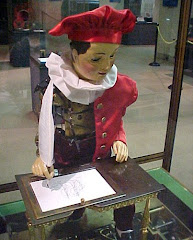
BOILERPLATE: Mechanical Marvel of the Nineteenth Century
Boilerplate was a mechanical man developed by Professor Archibald Campion during the 1880s and unveiled at the 1893 World's Columbian Exposition.
Built in a small Chicago laboratory, Boilerplate was originally designed as a prototype soldier for use in resolving the conflicts of nations. Although it was the only such prototype, Boilerplate was eventually able to exercise its proposed function by participating in several combat actions.
In the mid-1890s, Boilerplate embarked on a series of expeditions to demonstrate its abilities, the most ambitious being a voyage to Antarctica. Boilerplate is one of history's great ironies, a technological milestone that remains largely unknown. Even in an age that gave birth to the automobile and aeroplane, a functioning mechanical man should have been accorded more significance.
Read more.
Built in a small Chicago laboratory, Boilerplate was originally designed as a prototype soldier for use in resolving the conflicts of nations. Although it was the only such prototype, Boilerplate was eventually able to exercise its proposed function by participating in several combat actions.
In the mid-1890s, Boilerplate embarked on a series of expeditions to demonstrate its abilities, the most ambitious being a voyage to Antarctica. Boilerplate is one of history's great ironies, a technological milestone that remains largely unknown. Even in an age that gave birth to the automobile and aeroplane, a functioning mechanical man should have been accorded more significance.
Read more.
Nothing but the truth: Internet hoaxes
We all rely on the net for information and entertainment.But how can we spot where reality ends? Rhodri Marsden investigates
Monday, 6 October 2008, The Independent
You know something? There's a hilarious video doing the rounds on the internet at the moment. Now, this information obviously won't be forcing understaffed news desks across the globe to coax former reporters out of retirement; if your job involves the use of a computer, you'll do well to get through a working day without being sent a web-link to a video someone thinks is side-splitting.
But, as supposedly hilarious video clips go, this is a pretty good one. It features a well-groomed eight-piece band called Sonseed, all wearing their Sunday best, performing a ditsy little ska tune called "Jesus Is My Friend" on an early Eighties religious show on American TV – and if you haven't seen it, do force yourself to have a look; it's at d95.com/jesus. It has many of the ingredients of a copper-bottomed viral hit: dated haircuts, dubious fashion sense, questionable musical value and, above all, mind-boggling peculiarity.
Read article here.
Monday, 6 October 2008, The Independent
You know something? There's a hilarious video doing the rounds on the internet at the moment. Now, this information obviously won't be forcing understaffed news desks across the globe to coax former reporters out of retirement; if your job involves the use of a computer, you'll do well to get through a working day without being sent a web-link to a video someone thinks is side-splitting.
But, as supposedly hilarious video clips go, this is a pretty good one. It features a well-groomed eight-piece band called Sonseed, all wearing their Sunday best, performing a ditsy little ska tune called "Jesus Is My Friend" on an early Eighties religious show on American TV – and if you haven't seen it, do force yourself to have a look; it's at d95.com/jesus. It has many of the ingredients of a copper-bottomed viral hit: dated haircuts, dubious fashion sense, questionable musical value and, above all, mind-boggling peculiarity.
Read article here.
erik bünger: gospels (2006)
After long and painful research a picture started to emerge. Going through a vast amount of archive material I stumbled upon more and more interview clips where there seemed to be a lack of clarity as to whom the person on camera was actually referring to.
Yet they all spoke of Him. Sometimes the reports on Him seemed to reinforce each other and sometimes they seemed to contradict each other. Nevertheless there was something in the tone of their voices and in the way they raised their hands that made me sense some sort of coherence in their experience. Sometimes I felt I caught a glimpse of a silhouette reflected in their eyes.
Gospels is work with an open-ended duration. As new material is found new chapters will be added, slowly completing and complicating the picture. A canon in the making.
The project was initiated during a two-month residence at Werkleitz Gesellschaft in Halle, Germany in the spring of 2006.
erik bünger.
Yet they all spoke of Him. Sometimes the reports on Him seemed to reinforce each other and sometimes they seemed to contradict each other. Nevertheless there was something in the tone of their voices and in the way they raised their hands that made me sense some sort of coherence in their experience. Sometimes I felt I caught a glimpse of a silhouette reflected in their eyes.
Gospels is work with an open-ended duration. As new material is found new chapters will be added, slowly completing and complicating the picture. A canon in the making.
The project was initiated during a two-month residence at Werkleitz Gesellschaft in Halle, Germany in the spring of 2006.
erik bünger.
EKSIG CONFERENCE 2009
19 June 2009:
EKSIG 2009: EXPERIENTIAL KNOWLEDGE, METHOD AND
METHODOLOGY
International Conference 2009 of the DRS Special
Interest Group on Experiential Knowledge
The EKSIG International Conference 2009 will address the theme
of "Experiential Knowledge, Method and Methodology". It will be
convened by the DRS Special Interest Group on Experiential
Knowledge (EKSIG), and hosted by London Metropolitan University.
Organisers: Linden Reilly, Chris Smith, Kristina Niedderer,
Seymour Roworth-Stokes
Venue: London Metropolitan University, London, UK
Conference home page: http://www.experientialknowledge.org
Contact: info@experientialknowledge.org
FIRST CALL FOR PAPERS
For EKSIG 2009, we invite submissions for the theme
"Experiential Knowledge, Method and Methodology". With this
theme we aim to provide a forum for debate about methodology and
methods for the inclusion and communication of knowledge in
research and practice in the creative disciplines.
The need to be more explicit about research methods, frameworks,
and methodologies has arisen from the increasing use of creative
and professional practices as part of the practice of research
in recent years. While research guidelines and regulations have
been either generic enough, or were adjusted, to accommodate the
use of some creative and professional practices under certain
conditions, the debate about the nature, aims, validity,
evaluation, and necessity of such research has continued.
While all research has a method, and disciplines are
characteristically driven by debates about the best methods for
achieving their aims, that which constitutes a research method
in design and related disciplines is still a matter of debate.
The debates about research methods in design in many ways echo
questions addressed in the design methods movement of the 1960s
and 1970s, such as: 'What are design methods?' Now framed in
terms of design research, questions address the conditions under
which design methods might be used as research methods as well
as the nature of discipline specific methodologies.
The developing understanding in this debate is that the
inclusion of practice in the research process or as a research
outcome helps to integrate and/or communicate those kinds or
parts of knowledge that cannot easily be made explicit, such as
the tacit part of experiential and procedural knowledge,
commonly known as tacit knowledge. With this conference, we wish
to explore the different ways in which tacit knowledge can be
integrated and communicated within the framework of research.
Questions of interest are, for example:
- What are design methods and what are design research methods?
- How is knowledge/knowing created within the process of
research?
- What frameworks are there to guide discipline specific
methodologies?
- How can we integrate and utilize tacit knowledge in the
process of research?
- Why is the use of tacit knowledge important in research?
- What contribution can the use of practice make to the
inclusion of tacit knowledge in research?
- What contribution can the use of design practice make to the
development of design research?
- What methods are there for the communication of tacit
knowledge within research?
- Can we talk about the communication of tacit knowledge, or
should we talk about a transfer?
- What means and methods do we have to transfer tacit knowledge?
We wish to bring together people from different fields and
disciplines with different approaches to address these issues.
We invite contributions from the design disciplines (design,
engineering, craft, media etc), philosophy, education, health
and knowledge management that are concerned with methods and
methodology in research and in creative and professional
practice; with the nature, role, and management of knowledge
within research; and with the role and use of creative practice
(both as process and outcome) as a means by which to develop and
manage experiential/tacit knowledge within research.
SUBMISSIONS
For EKSIG 2009, we invite position papers, which offer
challenging new views on the subject. Position papers will be
selected subject to a double blind review process by an
international review team. In the first instance we ask for the
submission of abstracts. Authors of selected abstracts will be
asked to submit full papers.
We invite the submission of abstracts of 700-800 words
(excluding references) for position papers by 1st December 2008.
Abstracts should be sent as plain text in the body of the email
from the lead researcher's email address. Please send your
abstract via e-mail to info@experientialknowledge.org.uk
Authors of selected abstracts will subsequently be invited to
submit full papers (4000-5000w) in early 2009.
For further information, please visit:
http://www.experientialknowledge.org
EKSIG 2009: EXPERIENTIAL KNOWLEDGE, METHOD AND
METHODOLOGY
International Conference 2009 of the DRS Special
Interest Group on Experiential Knowledge
The EKSIG International Conference 2009 will address the theme
of "Experiential Knowledge, Method and Methodology". It will be
convened by the DRS Special Interest Group on Experiential
Knowledge (EKSIG), and hosted by London Metropolitan University.
Organisers: Linden Reilly, Chris Smith, Kristina Niedderer,
Seymour Roworth-Stokes
Venue: London Metropolitan University, London, UK
Conference home page: http://www.experientialknowledge.org
Contact: info@experientialknowledge.org
FIRST CALL FOR PAPERS
For EKSIG 2009, we invite submissions for the theme
"Experiential Knowledge, Method and Methodology". With this
theme we aim to provide a forum for debate about methodology and
methods for the inclusion and communication of knowledge in
research and practice in the creative disciplines.
The need to be more explicit about research methods, frameworks,
and methodologies has arisen from the increasing use of creative
and professional practices as part of the practice of research
in recent years. While research guidelines and regulations have
been either generic enough, or were adjusted, to accommodate the
use of some creative and professional practices under certain
conditions, the debate about the nature, aims, validity,
evaluation, and necessity of such research has continued.
While all research has a method, and disciplines are
characteristically driven by debates about the best methods for
achieving their aims, that which constitutes a research method
in design and related disciplines is still a matter of debate.
The debates about research methods in design in many ways echo
questions addressed in the design methods movement of the 1960s
and 1970s, such as: 'What are design methods?' Now framed in
terms of design research, questions address the conditions under
which design methods might be used as research methods as well
as the nature of discipline specific methodologies.
The developing understanding in this debate is that the
inclusion of practice in the research process or as a research
outcome helps to integrate and/or communicate those kinds or
parts of knowledge that cannot easily be made explicit, such as
the tacit part of experiential and procedural knowledge,
commonly known as tacit knowledge. With this conference, we wish
to explore the different ways in which tacit knowledge can be
integrated and communicated within the framework of research.
Questions of interest are, for example:
- What are design methods and what are design research methods?
- How is knowledge/knowing created within the process of
research?
- What frameworks are there to guide discipline specific
methodologies?
- How can we integrate and utilize tacit knowledge in the
process of research?
- Why is the use of tacit knowledge important in research?
- What contribution can the use of practice make to the
inclusion of tacit knowledge in research?
- What contribution can the use of design practice make to the
development of design research?
- What methods are there for the communication of tacit
knowledge within research?
- Can we talk about the communication of tacit knowledge, or
should we talk about a transfer?
- What means and methods do we have to transfer tacit knowledge?
We wish to bring together people from different fields and
disciplines with different approaches to address these issues.
We invite contributions from the design disciplines (design,
engineering, craft, media etc), philosophy, education, health
and knowledge management that are concerned with methods and
methodology in research and in creative and professional
practice; with the nature, role, and management of knowledge
within research; and with the role and use of creative practice
(both as process and outcome) as a means by which to develop and
manage experiential/tacit knowledge within research.
SUBMISSIONS
For EKSIG 2009, we invite position papers, which offer
challenging new views on the subject. Position papers will be
selected subject to a double blind review process by an
international review team. In the first instance we ask for the
submission of abstracts. Authors of selected abstracts will be
asked to submit full papers.
We invite the submission of abstracts of 700-800 words
(excluding references) for position papers by 1st December 2008.
Abstracts should be sent as plain text in the body of the email
from the lead researcher's email address. Please send your
abstract via e-mail to info@experientialknowledge.org.uk
Authors of selected abstracts will subsequently be invited to
submit full papers (4000-5000w) in early 2009.
For further information, please visit:
http://www.experientialknowledge.org
Against Nature: The Arts of the Machine - First Assignment
Preparation
Download/read the Fluxus Performance Workbook from the course blog for examples of performative instructions.
Groups
You are divided into three interdisciplinary teams according to the following themes:
1. Space
2. Time
3. Sound
Site:
All three groups work on the same site – i.e. the intersection between your studio space (marked 2. in Vita Havet) and Seminargatan.
Group 1 designs a system capable of generating an experience of space.
Group 2 designs a system capable of generating an experience of time.
Group 3 designs a system capable of generating an experience of sound.
Treat passers-by as well as the systems devised by the other two groups as your information; your system will generate an experience of its allocated theme and may be left to evolve over successive generations. Your system will be considered ’creative’ if it is generating unpredictable and appropriate outcomes, is responsive to its context and surroundings, and capable of interacting with the two neighbouring systems.
Deadline: set systems in motion 12.00 (lunchtime) Wednesday 8th October
Crit: 13.00 Wednesday 8th October, Vita Havet.
Download/read the Fluxus Performance Workbook from the course blog for examples of performative instructions.
Groups
You are divided into three interdisciplinary teams according to the following themes:
1. Space
2. Time
3. Sound
Site:
All three groups work on the same site – i.e. the intersection between your studio space (marked 2. in Vita Havet) and Seminargatan.
Group 1 designs a system capable of generating an experience of space.
Group 2 designs a system capable of generating an experience of time.
Group 3 designs a system capable of generating an experience of sound.
Treat passers-by as well as the systems devised by the other two groups as your information; your system will generate an experience of its allocated theme and may be left to evolve over successive generations. Your system will be considered ’creative’ if it is generating unpredictable and appropriate outcomes, is responsive to its context and surroundings, and capable of interacting with the two neighbouring systems.
Deadline: set systems in motion 12.00 (lunchtime) Wednesday 8th October
Crit: 13.00 Wednesday 8th October, Vita Havet.
Preparatory reading for Louise Mazanti's lecture
In advance of Professor Louise Mazanti's lecture (Tuesday 28 October 2008), please read:
Shales, Ezra: “Technophilic Craft”, American Craft Magazine, April/May 2008.
Shales, Ezra: “Technophilic Craft”, American Craft Magazine, April/May 2008.
Sunday, 5 October 2008
'Intelligent' computers put to the test'
And thanks to Willow for this:
'Intelligent' computers put to the test'
by David Smith
Can machines think? That was the question posed by the great mathematician Alan Turing. Half a century later six computers are about to converse with human interrogators in an experiment that will attempt to prove that the answer is yes.
Article.
'Intelligent' computers put to the test'
by David Smith
Can machines think? That was the question posed by the great mathematician Alan Turing. Half a century later six computers are about to converse with human interrogators in an experiment that will attempt to prove that the answer is yes.
Article.
Choose Your Own Adventure
Thanks to Natasha Llorens-Perkins for this:
Choose Your Own Adventure is a series of children's gamebooks first published by Bantam Books from 1979-1998 and currently being re-published by Chooseco. Each story is written from a second-person point of view, with the reader assuming the role of the protagonist and making choices that determine the main character's actions in response to the plot and its outcome. Choose Your Own Adventure was one of the most popular children’s series during the 1980s and 1990s, selling over 250 million copies between 1979 and 1998, and translated into at least 38 languages.
More.
Choose Your Own Adventure is a series of children's gamebooks first published by Bantam Books from 1979-1998 and currently being re-published by Chooseco. Each story is written from a second-person point of view, with the reader assuming the role of the protagonist and making choices that determine the main character's actions in response to the plot and its outcome. Choose Your Own Adventure was one of the most popular children’s series during the 1980s and 1990s, selling over 250 million copies between 1979 and 1998, and translated into at least 38 languages.
More.
From Original to Copy and Back Again
by James Elkins
Within aesthetics, exchanges about the nature of forgery have been made largely in response to Nelson Goodman’s Languages of Art (1968). In his original scenario we are invited to contemplate two paintings: one is authentic and the other is forged, but we cannot distinguish them by “merely looking,” without the aid of X-Rays and chemical analyses. Our different aesthetic response to the two paintings is used to argue, in the words of Joseph Margolis, that “there are bound to be aesthetically relevant considerations in the appreciation of art that are not directly accessible to perception or to any other relevant mode of experience.”[1] Historians have been largely silent during the debates on Goodman’s claim: not, I think, because it is not an important problem, but rather because what matters to historians are the imperceptible considerations in any given case, rather than the simple existence of such considerations.
Paper.
Within aesthetics, exchanges about the nature of forgery have been made largely in response to Nelson Goodman’s Languages of Art (1968). In his original scenario we are invited to contemplate two paintings: one is authentic and the other is forged, but we cannot distinguish them by “merely looking,” without the aid of X-Rays and chemical analyses. Our different aesthetic response to the two paintings is used to argue, in the words of Joseph Margolis, that “there are bound to be aesthetically relevant considerations in the appreciation of art that are not directly accessible to perception or to any other relevant mode of experience.”[1] Historians have been largely silent during the debates on Goodman’s claim: not, I think, because it is not an important problem, but rather because what matters to historians are the imperceptible considerations in any given case, rather than the simple existence of such considerations.
Paper.
The Authorship of Generative Art
How I Drew One of My Pictures: *
or, The Authorship of Generative Art
Adrian Ward BSc & Geoff Cox MA(RCA)
Abstract
The concept of value is traditionally bestowed on a work of art when it is seen to be unique and irreproducible, thereby granting it authenticity. Think of a famous painting: only the original canvas commands genuinely high prices.
Digital artwork is not valued in the same way. It can be copied infinitely and there is therefore a corresponding crisis of value. It has been argued that under these conditions of the dematerialised artwork, it is process that becomes valued. In this way, the process of creation and creativity is valued in place of authenticity, undermining conventional notions of authorship.
It is possible to correlate many of these creative processes into instructions. However, to give precise instructions on the construction of a creative work is a complex, authentic and intricate process equivalent to conventional creative work (and is therefore not simply a question of 'the death of the author'). This paper argues that to create 'generative' systems is a rigorous and intricate procedure. Moreover, the output from generative systems should not be valued simply as an endless, infinite series of resources but as a system. To have a machine write poetry for ten years would not generate creative music, but the process of getting the machine to do so would certainly register an advanced form of creativity.
When a programmer develops a generative system, they are engaged in a creative act. Programming is no less an artform than painting is a technical process. By analogy, the mathematical value pi can be approximated as 3.14159265, but a more thorough and accurate version can be stored as the formula used to calculate it. In the same way, it is more complete to express creativity formulated as code, which can then be executed to produce the results we desire. Rather like using Leibnitz's set of symbols to represent a mathematical formula, artists can now choose to represent creativity as computer programs (Harold Cohen's Aaron, a computer program that creates drawings is a case in point).
By programming computers to undertake creative instructions, this paper will argue that more accurate and expansive traces of creativity are being developed that suitably merge artistic subjectivity with technical form. It is no longer necessary or even desirable to be able to render art as a final tangible medium, but instead it is more important to program computers to be creative by proxy.
Paper.
or, The Authorship of Generative Art
Adrian Ward BSc & Geoff Cox MA(RCA)
Abstract
The concept of value is traditionally bestowed on a work of art when it is seen to be unique and irreproducible, thereby granting it authenticity. Think of a famous painting: only the original canvas commands genuinely high prices.
Digital artwork is not valued in the same way. It can be copied infinitely and there is therefore a corresponding crisis of value. It has been argued that under these conditions of the dematerialised artwork, it is process that becomes valued. In this way, the process of creation and creativity is valued in place of authenticity, undermining conventional notions of authorship.
It is possible to correlate many of these creative processes into instructions. However, to give precise instructions on the construction of a creative work is a complex, authentic and intricate process equivalent to conventional creative work (and is therefore not simply a question of 'the death of the author'). This paper argues that to create 'generative' systems is a rigorous and intricate procedure. Moreover, the output from generative systems should not be valued simply as an endless, infinite series of resources but as a system. To have a machine write poetry for ten years would not generate creative music, but the process of getting the machine to do so would certainly register an advanced form of creativity.
When a programmer develops a generative system, they are engaged in a creative act. Programming is no less an artform than painting is a technical process. By analogy, the mathematical value pi can be approximated as 3.14159265, but a more thorough and accurate version can be stored as the formula used to calculate it. In the same way, it is more complete to express creativity formulated as code, which can then be executed to produce the results we desire. Rather like using Leibnitz's set of symbols to represent a mathematical formula, artists can now choose to represent creativity as computer programs (Harold Cohen's Aaron, a computer program that creates drawings is a case in point).
By programming computers to undertake creative instructions, this paper will argue that more accurate and expansive traces of creativity are being developed that suitably merge artistic subjectivity with technical form. It is no longer necessary or even desirable to be able to render art as a final tangible medium, but instead it is more important to program computers to be creative by proxy.
Paper.
Thursday, 2 October 2008
Themes for AN meetings
1. on rules (AF) Wednesday 1/10
2. Second Nature (RH) Thursday
3. OULIPO + Collage (AF+RH) Friday
4. Alterity: set a trap (student work) Monday.
5. Alterity crit (all) Tuesday
6. Hacking seminar + assignment Thursday.
7. Hacking crit. Monday.
8. Presentation and discussion of final assignment. Tuesday.
9+. Own work with supervision from AF+RH
2. Second Nature (RH) Thursday
3. OULIPO + Collage (AF+RH) Friday
4. Alterity: set a trap (student work) Monday.
5. Alterity crit (all) Tuesday
6. Hacking seminar + assignment Thursday.
7. Hacking crit. Monday.
8. Presentation and discussion of final assignment. Tuesday.
9+. Own work with supervision from AF+RH
Thursday, 25 September 2008
"Conscious Machines: Memory, Melody and Imagination"
by Susan A.J. Stewart
At first glance the question, ''Will conscious machines perform better than 'unconscious' machines?'', seems innocuous or, at least, to elicit a straightforward positive response, but it prompts the question, ''Perform what?''. If the aim is to produce a machine that will perform as a human being or other phenomenally conscious agent in an intersubjectively-demanding social and moral environment, then there can be little doubt that a conscious machine would out-perform an `unconscious' machine. But there are also circumstances in which a conscious, empathetic, decision-making, risk-taking agent would be a distinct disadvantage, and I will allude to circumstances of this kind briefly towards the end of the paper.
Following on from Damasio's [1991, 1994, 1999, 2003] claims for the necessity of pre-reflective conscious, emotional, bodily responses for the development of an organism's core and extended consciousness, I will argue that without these capacities any agent would be significantly less likely to make effective decisions and survive. Moreover, I will argue that machine phenomenology is only possible within a distributed system that possesses a subtle musculature and a nervous system such that it can, through action and repetition, develop its kinaesthetic memory, individual kinaesthetic melodies, and an enactive kinaesthetic imagination. Without these capacities a potentially conscious machine would remain unconscious. It would be without the necessary nuanced somatosensory awareness of its active engagement, even if that action is to some extent goal-directed, and would be incapable of developing the sorts of somatic markers or saliency tags that enable affective reactions, and which are indispensable for effective decision-making.
Available here.
Accepted for presentation at the Association for the Advancement of Artificial Intelligence (AAAI), Washington, VA., 7-11 November 2007, and to appear in the Proceedings of FSS-07: AI and Consciousness: Theoretical Foundations and Current Approaches.
At first glance the question, ''Will conscious machines perform better than 'unconscious' machines?'', seems innocuous or, at least, to elicit a straightforward positive response, but it prompts the question, ''Perform what?''. If the aim is to produce a machine that will perform as a human being or other phenomenally conscious agent in an intersubjectively-demanding social and moral environment, then there can be little doubt that a conscious machine would out-perform an `unconscious' machine. But there are also circumstances in which a conscious, empathetic, decision-making, risk-taking agent would be a distinct disadvantage, and I will allude to circumstances of this kind briefly towards the end of the paper.
Following on from Damasio's [1991, 1994, 1999, 2003] claims for the necessity of pre-reflective conscious, emotional, bodily responses for the development of an organism's core and extended consciousness, I will argue that without these capacities any agent would be significantly less likely to make effective decisions and survive. Moreover, I will argue that machine phenomenology is only possible within a distributed system that possesses a subtle musculature and a nervous system such that it can, through action and repetition, develop its kinaesthetic memory, individual kinaesthetic melodies, and an enactive kinaesthetic imagination. Without these capacities a potentially conscious machine would remain unconscious. It would be without the necessary nuanced somatosensory awareness of its active engagement, even if that action is to some extent goal-directed, and would be incapable of developing the sorts of somatic markers or saliency tags that enable affective reactions, and which are indispensable for effective decision-making.
Available here.
Accepted for presentation at the Association for the Advancement of Artificial Intelligence (AAAI), Washington, VA., 7-11 November 2007, and to appear in the Proceedings of FSS-07: AI and Consciousness: Theoretical Foundations and Current Approaches.
After Nature/themes for meetings
1. on rules (AF) Wednesday 1/10
2. Second Nature (RH) Thursday
3. OULIPO + Collage (AF+RH) Friday
4. Alterity: set a trap in city for disrupting existing flow and capturing (student work) Monday.
5. Alterity crit (all) Tuesday
6. Hacking seminar; assignment for next Monday; redesign seminar as pedagogical experience (include interior, furniture, language, architecture, behaviour, role, gender etc) Thursday.
7. Seminar (designed by students) crit. Monday.
8. Presentation and discussion of final assignment. Tuesday.
9. Own work.
2. Second Nature (RH) Thursday
3. OULIPO + Collage (AF+RH) Friday
4. Alterity: set a trap in city for disrupting existing flow and capturing (student work) Monday.
5. Alterity crit (all) Tuesday
6. Hacking seminar; assignment for next Monday; redesign seminar as pedagogical experience (include interior, furniture, language, architecture, behaviour, role, gender etc) Thursday.
7. Seminar (designed by students) crit. Monday.
8. Presentation and discussion of final assignment. Tuesday.
9. Own work.
Subscribe to:
Posts (Atom)